
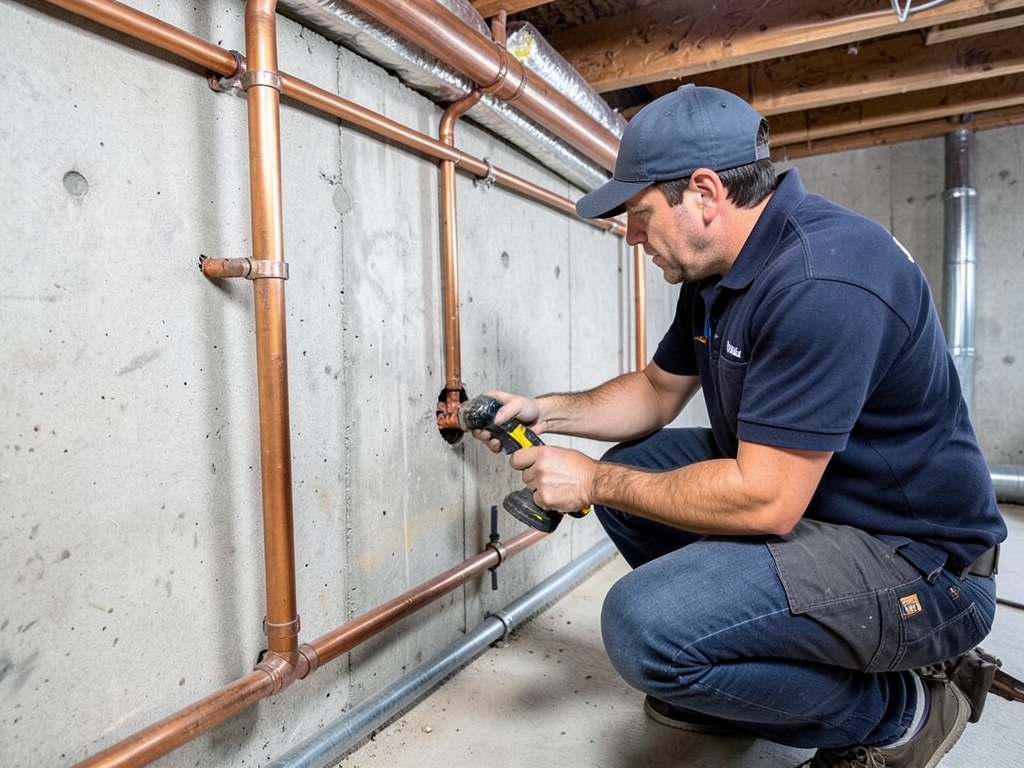
Stopping pipe condensation from dripping on your Warren basement floor
Your basement pipes are dripping water and you’re not sure if it’s a leak or something else. The good news is that in most Warren homes during Michigan’s humid summers, those dripping pipes are likely just condensation forming on cold water lines. This happens when warm, moisture-laden air hits cold pipe surfaces and creates water droplets that can damage your floors, walls, and stored items. Michigan Residential Code.
Before you call a plumber, you need to know if you’re dealing with a real leak or just pipe sweating. The paper towel test takes 30 seconds: dry the pipe completely and wrap it with a paper towel. If the towel stays dry for several hours, you’ve got condensation. If it gets wet from the outside in, you likely have a pinhole leak that needs immediate attention. Why Your Corktown Home Needs a Professional Sewer Line Inspection Before You Buy.
Warren’s location in southeast Michigan means your basement faces unique humidity challenges. The area’s heavy clay soil and high water table create conditions where summer air can hold significant moisture, making pipe condensation a seasonal problem that peaks from June through September.
Why Are My Pipes Sweating? (The Science of Condensation)
Condensation on pipes is basic thermodynamics at work. When cold water flows through copper or PEX pipes, the pipe surface temperature drops below the dew point of the surrounding air. The dew point is the temperature at which water vapor in the air turns into liquid water. In Warren basements, where summer humidity often exceeds 70%, this happens frequently.
Detroit’s climate data shows that July and August average relative humidity levels around 75-80% during the day. When that warm, moist air contacts a cold water pipe carrying groundwater that’s typically 45-55 degrees Fahrenheit, condensation forms almost immediately. The problem worsens in finished basements with poor ventilation or where air conditioning creates cold spots.
Pipe material matters too. Copper pipes conduct heat better than PEX, so they cool down faster and sweat more. Older galvanized steel pipes in Warren’s post-war homes can actually rust from the inside out, creating rough surfaces where condensation collects and drips more heavily than on smooth copper or PEX.
The Michigan Residential Code requires proper pipe insulation in certain applications, but many older Warren homes were built before these standards existed. This leaves homeowners dealing with the consequences of decades of seasonal pipe sweating that can lead to mold growth, wood rot, and damaged flooring.
Is it a Leak or Just Condensation?
Distinguishing between a leak and condensation saves you time and money. Here’s a simple diagnostic test you can perform right now:
- Visual Inspection
Look for water patterns. Condensation forms uniform droplets that run down the pipe length. Leaks create isolated wet spots or steady drips from one location.
- The Paper Towel Test
Wrap dry paper towels around the wet area and secure with tape. Check after 30 minutes. If the outside of the towel gets wet, you have a leak. If only the side touching the pipe gets damp, it’s condensation.
- Pressure Test
Turn off all water in the house and watch the water meter. If it’s still moving, you have a leak somewhere in the system.
- Temperature Check
Touch the pipe. Condensation feels uniformly cool along its length. A leak often feels warmer where water is actively flowing out.
Common leak locations in Warren homes include joints, valves, and areas where pipes pass through concrete walls. These spots often show corrosion or mineral deposits that condensation doesn’t create. If you see green or white crusty buildup, that’s a sign of slow corrosion from either a tiny leak or years of condensation exposure.
Step-by-Step DIY Solutions for Sweating Pipes
Stopping pipe condensation doesn’t require professional help in most cases. Here are proven solutions that work in Warren’s climate:
Self-Sealing Foam Insulation (Polyethylene)
Foam pipe insulation is the quickest fix for sweating pipes. The slit design lets you install it without disconnecting anything. For Warren basements, use insulation with at least R-4 rating to handle our humidity levels.
Installation steps:
- Measure pipe diameter and length to buy the correct size
- Clean pipes with a dry cloth to remove dust and moisture
- Open the insulation slit and snap it around the pipe
- Seal the seam with the factory adhesive or foil tape
- Overlap joints by at least 1/2 inch for complete coverage
Foam insulation costs about $1-2 per linear foot and is available at any Detroit-area hardware store. The material is lightweight and easy to cut with a utility knife. For pipes in tight spaces, consider using smaller diameter sections and connecting them.
Rubber Pipe Insulation (Armaflex)
For severe condensation problems, rubber insulation provides better moisture resistance than foam. Armaflex and similar closed-cell elastomeric materials create a vapor barrier that prevents moisture from reaching the pipe surface.
Rubber insulation advantages:
- Higher R-value per inch (typically R-4 to R-5)
- Better moisture resistance in humid conditions
- More durable and less prone to damage
- Available in various wall thicknesses
Installation requires more precision than foam. You’ll need to cut the material to fit around fittings and use contact cement or specialized tape to seal joints. The material costs $2-4 per linear foot but lasts longer in Warren’s damp basements.
Anti-Sweat Valve Installation (for toilets)
Toilet tanks sweat badly in summer because cold water constantly refills them. An anti-sweat valve mixes hot and cold water to raise the tank temperature above the dew point. Commercial Toilet & Urinal Repair.
Installation process:
- Turn off water supply and flush the toilet
- Remove the supply line from the tank
- Install the anti-sweat valve on the supply line
- Connect hot and cold supply lines to the valve
- Adjust the mixing ratio for your basement temperature
These valves cost $15-30 and can be installed in about an hour. They’re particularly effective in finished basements where toilet sweat can damage flooring and create slip hazards.
Managing Basement Humidity with Dehumidifiers
Even with pipe insulation, high basement humidity will cause condensation problems. A good dehumidifier addresses the root cause by removing moisture from the air.
Dehumidifier selection guide:
| Basement Size | Recommended Capacity | Daily Removal | Approximate Cost |
|---|---|---|---|
| Up to 1,500 sq ft | 30-pint | 30-40 pints | $200-300 |
| 1,500-2,500 sq ft | 50-pint | 50-60 pints | $300-400 |
| Over 2,500 sq ft | 70-pint or whole-house | 70+ pints | $400-800 |
Place the dehumidifier in the center of your basement for best coverage. Empty the collection bucket regularly or install a continuous drain hose to a floor drain. In Warren’s humid summers, expect to run the unit continuously from June through September. The Best Drain Cleaning Services for Older Houses in Grosse Pointe.
Combine dehumidification with ventilation. Open basement windows on cool, dry days to exchange moist air. Use exhaust fans when showering or cooking upstairs to prevent humidity from migrating downstairs.
When to Call a Professional Detroit Plumber
DIY solutions work for most condensation problems, but certain situations require professional help. Here are the warning signs that indicate you need a licensed plumber:
Persistent moisture after insulation – If you’ve insulated all visible pipes and still see water damage, you might have hidden leaks in walls or under floors. A plumber can use moisture meters and thermal imaging to locate the source.
Mold growth beyond surface level – Surface mold on insulation suggests deeper moisture problems. Professional remediation may be needed if mold has penetrated drywall or wood framing. The EPA recommends professional removal for areas larger than 10 square feet.
Structural damage signs – Warped flooring, crumbling drywall, or soft wood indicates long-term moisture exposure that has compromised structural integrity. This requires both plumbing repair and building restoration.
High water pressure issues – Excessive water pressure (over 80 psi) can cause pipes to sweat more and may indicate failing pressure regulators. A plumber can test your pressure and install a regulator if needed.
Old galvanized pipes – Homes built before 1960 often have galvanized steel pipes that rust internally. These pipes sweat more and may be near the end of their service life. Replacement with copper or PEX might be the most cost-effective long-term solution.
Professional services typically cost $150-300 for diagnosis and $500-2,000 for comprehensive solutions depending on the extent of the problem. In Warren, many plumbers offer free estimates for condensation assessment. The Most Trusted Plumbers for Historical Home Pipe Restoration in Indian Village.
Long-Term Prevention for Michigan Homes
Preventing pipe condensation requires a systematic approach that addresses both the pipes and the basement environment. Here’s how to create a moisture-resistant basement system:
Crawl space encapsulation – While not all Warren homes have crawl spaces, those that do benefit from encapsulation. This involves sealing the ground with vapor barrier, insulating walls, and conditioning the air. The process costs $3,000-8,000 but can reduce basement humidity by 30-50%.
Proper grading and drainage – Water should flow away from your foundation. The ground should slope at least 6 inches over 10 feet from your house. Extend downspouts at least 5 feet from the foundation and clean gutters regularly to prevent overflow.
Basement waterproofing – Interior waterproofing systems include sealants on walls and floors, drainage channels, and sump pumps. For severe cases, exterior waterproofing may be needed, involving excavation and membrane application. Costs range from $2,000-10,000 depending on the scope.
Whole-house humidity control – Your HVAC system plays a crucial role in humidity management. Ensure your air conditioner is properly sized – an oversized unit cools too quickly without removing enough moisture. Consider adding a whole-house dehumidifier that works with your existing system.
Regular maintenance schedule – Check your basement monthly during summer for signs of moisture. Clean dehumidifier filters quarterly. Inspect pipe insulation annually and replace any damaged sections. Test your sump pump before the rainy season each spring.
Warren’s specific challenges include the area’s high clay content soil that retains water and the proximity to Lake St. Clair which influences local humidity levels. Homes in flood-prone areas near the Red Run Drain may need additional waterproofing measures.
The Michigan Residential Code Section R322 requires proper moisture control in basements, including vapor barriers and drainage systems. While these codes focus on new construction, they provide guidelines for effective moisture management in existing homes.
For homes with finished basements, consider using moisture-resistant materials like cement board instead of drywall in areas prone to humidity. Install ceiling fans to improve air circulation and prevent cold spots where condensation forms.
Remember that pipe condensation is often a symptom of larger humidity issues. Addressing the root cause through comprehensive moisture control provides the best long-term protection for your Warren home.
Frequently Asked Questions
Why do my pipes only sweat in summer?
Pipes sweat when the surrounding air is warm and humid enough that its dew point exceeds the pipe temperature. In Michigan, summer humidity levels create these conditions, while winter air is typically too dry for significant condensation to form.
Can pipe insulation cause problems if installed incorrectly?
Yes. If insulation has gaps or is installed over existing moisture, it can trap water against pipes and accelerate corrosion. Always ensure pipes are dry before installation and seal all joints completely to prevent air infiltration.
How much does professional pipe insulation cost in Warren?
Professional insulation for an average basement costs $500-1,500 depending on the linear feet of pipe and accessibility. This includes labor and materials. Complex installations with many fittings or hard-to-reach areas may cost more.
Will a dehumidifier eliminate pipe sweating completely?
A dehumidifier significantly reduces condensation but may not eliminate it entirely. For complete prevention, combine dehumidification with pipe insulation. The dehumidifier addresses the air moisture while insulation protects the pipes directly.
Should I be concerned about mold from pipe condensation?
Yes. Even small amounts of condensation can create conditions for mold growth over time. Mold can start growing within 24-48 hours of moisture exposure. Address condensation promptly to prevent health hazards and structural damage.
Call (313) 572-4144 today to schedule your inspection. Our Warren plumbers can diagnose your condensation problem and recommend the right solution for your home. Don’t wait until water damage becomes expensive repairs. EPA mold guidelines.
You may also find this helpful. Fixing a vibrating or noisy sump pump in your Lincoln Park basement.
You may also find this helpful. Emergency Frozen Pipe Thawing in Brightmoor and Northwest Detroit.
{
“@context”: “https://schema.org”,
“@type”: “BlogPosting”,
“headline”: “Stopping pipe condensation from dripping on your Warren basement floor”,
“description”: “Learn why your pipes are sweating in Warren’s humid summers and how to stop condensation from damaging your basement. Expert DIY tips and professional solutions.”,
“wordCount”: 2018,
“datePublished”: “2026-04-12T08:14:00.000Z”,
“dateModified”: “2026-04-12T08:14:00.000Z”,
“inLanguage”: “en-US”,
“mainEntityOfPage”: {
“@type”: “WebPage”,
“@id”: “https://ironwoodplumbingdetroit.com”
},
“publisher”: {
“@type”: “LocalBusiness”,
“name”: “Ironwood Plumbing Detroit”,
“url”: “https://ironwoodplumbingdetroit.com”
},
“author”: {
“@type”: “Organization”,
“name”: “Ironwood Plumbing Detroit”,
“url”: “https://ironwoodplumbingdetroit.com”
},
“image”: {
“@type”: “ImageObject”,
“url”: “https://ironwoodplumbingdetroit.com/wp-content/uploads/2026/03/stopping-pipe-condensation-from-dripping-on-your-w-1.png”
}
}
{
“@context”: “https://schema.org”,
“@type”: “Plumber”,
“name”: “Ironwood Plumbing Detroit”,
“url”: “https://ironwoodplumbingdetroit.com”,
“address”: {
“@type”: “PostalAddress”,
“addressLocality”: “Detroit”
},
“areaServed”: {
“@type”: “City”,
“name”: “Detroit”
}
}
{
“@context”: “https://schema.org”,
“@type”: “FAQPage”,
“mainEntity”: [
{
“@type”: “Question”,
“name”: “Is it a Leak or Just Condensation?”,
“acceptedAnswer”: {
“@type”: “Answer”,
“text”: “Distinguishing between a leak and condensation saves you time and money. Here’s a simple diagnostic test you can perform right now:”
}
},
{
“@type”: “Question”,
“name”: “Why do my pipes only sweat in summer?”,
“acceptedAnswer”: {
“@type”: “Answer”,
“text”: “Pipes sweat when the surrounding air is warm and humid enough that its dew point exceeds the pipe temperature. In Michigan, summer humidity levels create these conditions, while winter air is typically too dry for significant condensation to form.”
}
},
{
“@type”: “Question”,
“name”: “Can pipe insulation cause problems if installed incorrectly?”,
“acceptedAnswer”: {
“@type”: “Answer”,
“text”: “Yes. If insulation has gaps or is installed over existing moisture, it can trap water against pipes and accelerate corrosion. Always ensure pipes are dry before installation and seal all joints completely to prevent air infiltration.”
}
},
{
“@type”: “Question”,
“name”: “How much does professional pipe insulation cost in Warren?”,
“acceptedAnswer”: {
“@type”: “Answer”,
“text”: “Professional insulation for an average basement costs $500-1,500 depending on the linear feet of pipe and accessibility. This includes labor and materials. Complex installations with many fittings or hard-to-reach areas may cost more.”
}
},
{
“@type”: “Question”,
“name”: “Will a dehumidifier eliminate pipe sweating completely?”,
“acceptedAnswer”: {
“@type”: “Answer”,
“text”: “A dehumidifier significantly reduces condensation but may not eliminate it entirely. For complete prevention, combine dehumidification with pipe insulation. The dehumidifier addresses the air moisture while insulation protects the pipes directly.”
}
},
{
“@type”: “Question”,
“name”: “Should I be concerned about mold from pipe condensation?”,
“acceptedAnswer”: {
“@type”: “Answer”,
“text”: “Yes. Even small amounts of condensation can create conditions for mold growth over time. Mold can start growing within 24-48 hours of moisture exposure. Address condensation promptly to prevent health hazards and structural damage.”
}
}
]
}
{
“@context”: “https://schema.org”,
“@type”: “HowTo”,
“name”: “Diagnosing Pipe Moisture”,
“step”: [
{
“@type”: “HowToStep”,
“position”: 1,
“name”: “Visual Inspection”,
“text”: “Look for water patterns. Condensation forms uniform droplets that run down the pipe length. Leaks create isolated wet spots or steady drips from one location.”
},
{
“@type”: “HowToStep”,
“position”: 2,
“name”: “The Paper Towel Test”,
“text”: “Wrap dry paper towels around the wet area and secure with tape. Check after 30 minutes. If the outside of the towel gets wet, you have a leak. If only the side touching the pipe gets damp, it’s condensation.”
},
{
“@type”: “HowToStep”,
“position”: 3,
“name”: “Pressure Test”,
“text”: “Turn off all water in the house and watch the water meter. If it’s still moving, you have a leak somewhere in the system.”
},
{
“@type”: “HowToStep”,
“position”: 4,
“name”: “Temperature Check”,
“text”: “Touch the pipe. Condensation feels uniformly cool along its length. A leak often feels warmer where water is actively flowing out.”
}
],
“image”: “https://ironwoodplumbingdetroit.com/wp-content/uploads/2026/03/stopping-pipe-condensation-from-dripping-on-your-w-1.png”
}
{
“@context”: “https://schema.org”,
“@type”: “BreadcrumbList”,
“itemListElement”: [
{
“@type”: “ListItem”,
“position”: 1,
“name”: “Home”,
“item”: “https://ironwoodplumbingdetroit.com”
},
{
“@type”: “ListItem”,
“position”: 2,
“name”: “Blog”,
“item”: “https://ironwoodplumbingdetroit.com/blog”
},
{
“@type”: “ListItem”,
“position”: 3,
“name”: “Stopping pipe condensation from dripping on your Warren basement floor”
}
]
}
{
“@context”: “https://schema.org”,
“@type”: “Service”,
“serviceType”: “Plumbing”,
“provider”: {
“@type”: “LocalBusiness”,
“name”: “Ironwood Plumbing Detroit”,
“url”: “https://ironwoodplumbingdetroit.com”
},
“areaServed”: {
“@type”: “City”,
“name”: “Detroit”
},
“description”: “Learn why your pipes are sweating in Warren’s humid summers and how to stop condensation from damaging your basement. Expert DIY tips and professional solutions.”
}